Verified schedule across cricket, football and kabaddi. The match centre is the live desk for today's play, with score reads, captain takes and form arrows attached to every fixture. Tap a fixture for the full report.
The live block refreshes every 90 seconds during play. Each fixture carries the venue, the format chip, the captain read and the form arrow for the day. Where a match is past the toss, the read is locked. Where the toss hasn't happened, the read is provisional — zocket marks these clearly so you never confuse a confirmed read with a forecast.
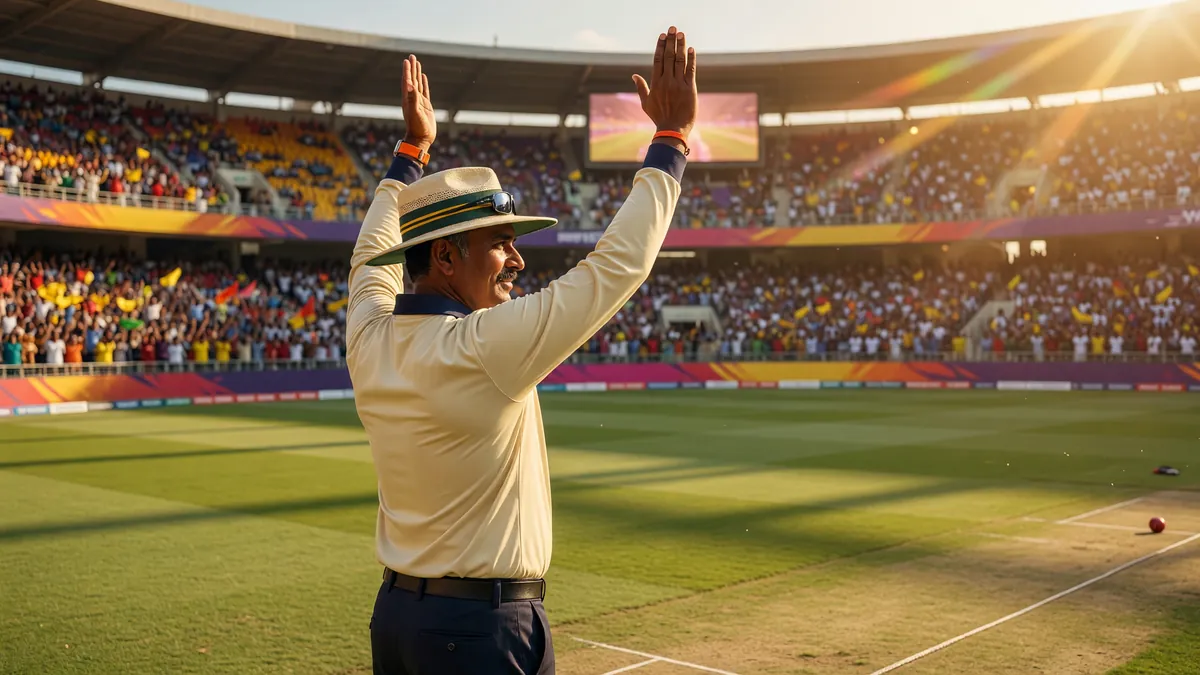
Umpire signal · centre-of-pitch decision · live desk coverage
Upcoming this week
Three formats in the next seven days: the unofficial ODI between India A and Australia A in Bengaluru, the ISL Round 3 fixture between Mumbai City and Bengaluru FC, and the Lord's Test between England Women and India Women. Each is anchored to a captain read and a form arrow; the desk updates the read on the morning of the toss.
Recent results
Yesterday's results are listed with the form arrow, the impact points, and the points-system reference. Where a matchup was decided by a captain move, the desk publishes a short note explaining the move and the alternative. Where a captain move backfired, the desk publishes that too.
How match reads are written
Every match read starts with the squad sheet, moves to the pitch report, then to the form laboratory. The desk does not publish reads before the toss, and provisional reads are always labelled. The verification stamp at the top of the page carries the last-update timestamp; the corrections desk publishes any error in the open within 24 hours.
Match centre FAQ
How often does the live block refresh? Every 90 seconds. Where does the score data come from? Verified feeds from BCCI, ECB, ICC, ISL and PKL. What if a read is wrong? Write to the desk — [email protected] — and the next edition carries the correction.
How to read a fixture card
The fixture card is the smallest unit of the match centre. It carries four fields: the two sides, the venue, the format chip, and the start time. Each is loaded from a verified feed, not a copy-paste from last week. Where a side is missing from the squad list, the card is provisional. Where a venue is moving (a T20 league with mid-season switches), the card carries a "venue subject to change" tag.
Captaincy flow on the match centre
The match centre is the front door to the desk's captain evidence. Each fixture links to a captain read, a hedge, and a differential. The captain read is the high-confidence pick; the hedge is the vice-captain; the differential is the low-ownership, high-upside punt for grand leagues. The three are derived, not selected — they come out of the same evidence stack, with different weights applied.
Live, closed, and provisional
Every fixture on the match centre carries one of three states: live (the ball is in play, the score updates every 90 seconds), closed (the match is over, the read is locked), or provisional (the toss hasn't happened, the read is on the squad sheet). Provisional reads are clearly labelled, and the desk never publishes a captain read on a provisional state — the desk waits for the toss.
Format colour and what it means
The format chip on the fixture card carries a colour: T20 is red (the boundary economy), ODI is blue (the accumulator game), Test is amber (the duel of patience), T10 is deep blue (the sprint). The colour is consistent across the desk — the fixture card, the format primer, the form laboratory, and the predictions desk all use the same chip, so a captain read in the form laboratory lines up with a fixture on the match centre.
Venue and state eligibility
The match centre does not publish a fixture for a real-money game in a state where the desk's app is restricted. The eligible-state list is on the app's signup page. Editorial coverage is nationwide; the app's signup route is state-gated.
More fixtures, more formats
The match centre is not just cricket. Football, kabaddi, and volleyball fixtures appear on the same card grid, with the same four fields and the same colour code. The desk's coverage of football and kabaddi is the same evidence-first approach: squads, form, captain reads. The match centre is the unified desk.
Match centre archive
Yesterday's fixtures are kept in the archive for 30 days. The archive carries the final score, the captain read, the form arrow, and the corrections log. Where a read was wrong, the archive links to the public correction. The archive is not paginated — it scrolls.
Carry the desk in your pocket
Live scores, captain reads, fixture ladder, last-five form — all in the zocket app.
The desk's match centre pulls from the verified broadcaster feed for the marquee cricket, football, and kabaddi fixtures. The feed carries the score, the over count, the batsmen at the crease, the bowler in operation, the fall of wickets, the partnership, and the run rate. The desk does not invent a feed. Where the feed is delayed, the desk publishes a "feed delayed" tag on the match card. The feed is the desk's evidence base — every captain read, differential, and hedge is built on the feed, the form laboratory, and the pitch report.
Captain evidence on the fixture
Each fixture card on the match centre links to a captain read. The captain read carries the form arrow, the role-fit score, the venue record, and the matchup score. The captain read is published in the form laboratory and on the predictions desk. The fixture card is the front door; the captain read is the back. The desk does not publish a captain read without a fixture card, and the desk does not publish a fixture card without a captain read.
Match centre archive
Yesterday's fixtures are kept in the archive for 30 days. The archive carries the final score, the captain read, the form arrow, and the corrections log. Where a read was wrong, the archive links to the public correction. The archive is the desk's memory. The archive is searchable by team, by format, and by date.
Match centre corrections
Where a score is wrong, the corrections desk publishes a public correction within 24 hours. Where a read is wrong, the corrections desk publishes a public correction within 24 hours. The corrections log is on the corrections page. The desk's accountability is in the open. The corrections are linked from the affected fixture cards in the archive.
Extended reading
The match centre is the desk's live surface. The form laboratory is the desk's evidence base. The captain evidence desk is the desk's picks. The three are designed to be read together — a captain read without a match centre is a pick without a fixture; a match centre without a captain read is a fixture without a pick. The desk's editorial system is the three, not any one alone.
Working with broken feeds
Where the verified broadcaster feed is delayed, the desk publishes a "feed delayed" tag on the match card. The desk does not invent a feed. The desk does not publish a guessed score. The desk publishes the tag and waits. The verification is in the tag. The desk's accountability is in the corrections log.
The desk on T20 leagues
The desk covers the IPL, the BBL, the CPL, the PSL, the Hundred, and the SA20. The desk's coverage of the IPL is the most extensive — every match, every captain read, every form arrow. The desk's coverage of the other T20 leagues is fixture-led, with a captain read on the marquee matchups. The desk's editorial line is the same across all T20 leagues — match context, player form, captain reads.
The desk on ODI cricket
The desk covers bilateral ODIs, the World Cup, the Champions Trophy, and the Asia Cup. The desk's coverage of the ODI format is the form laboratory and the captain evidence desk. The desk's coverage of the World Cup is the most extensive — every match, every captain read, every form arrow. The desk's editorial line is the same across all ODI cricket — match context, player form, captain reads.